
Annual Salamander Migration Captures Northeast Ohio’s Attention Every Spring
Local amphibians emerge and migrate each spring to mate, drawing in crowds of onlookers — and forcing protective measures to keep them safe.
by Annie Nickoloff | Mar. 6, 2026 | 5:00 AM

Photographed by Gabe Leidy
Nothing could have prepared the Cleveland Metroparks’ amphibian patrol team for the influx of interest in the 2025 salamander migration.
The 14-member group waited in the evening mist on one particularly popular night, watching person after person, flashlight after flashlight, approach the park system’s most well-known viewing point. Lights bobbed along the pathway and scanned the dewy ground for critters.
As salamanders and frogs scuttled across roadways and spring grass, a total of 442 people — hundreds more than in prior years — huddled to get a glimpse. Some people scooped them up, posing with the animals for photos. Some stepped off the paths and into the woods, inadvertently risking squishing the animals.
“When I see the lights, I’m happy and sad,” says Min-Sui Keung, Cleveland Metroparks Nature Center manager. “I’m happy that people are excited. I’m sad, because there are so many people going. We stopped vehicular traffic. Foot traffic can also cause mortality.”
Last year, Keung and her small team struggled to keep up with the crowds at their peak.
“The numbers were too high,” Keung says. “It was, like, Are there more people than amphibians? I think there are.”
Cleveland Magazine agreed not to name the specific Cleveland Metroparks location in this article in the interest of protecting the animal, which can be seen migrating in parts of Eastern North America this time of year.
To prepare for this year’s migration, Keung has already recruited more amphibian ambassadors to patrol the popular viewing areas, monitor crowds and advise respectful viewing. Additionally, Cleveland Metroparks will close more roadways for the duration of the migration, which spans from March to early April.
“I’m excited that people want to connect with nature,” Keung says, “but we’ve got to help these critters, right? We’ve got to help them cross the road.”
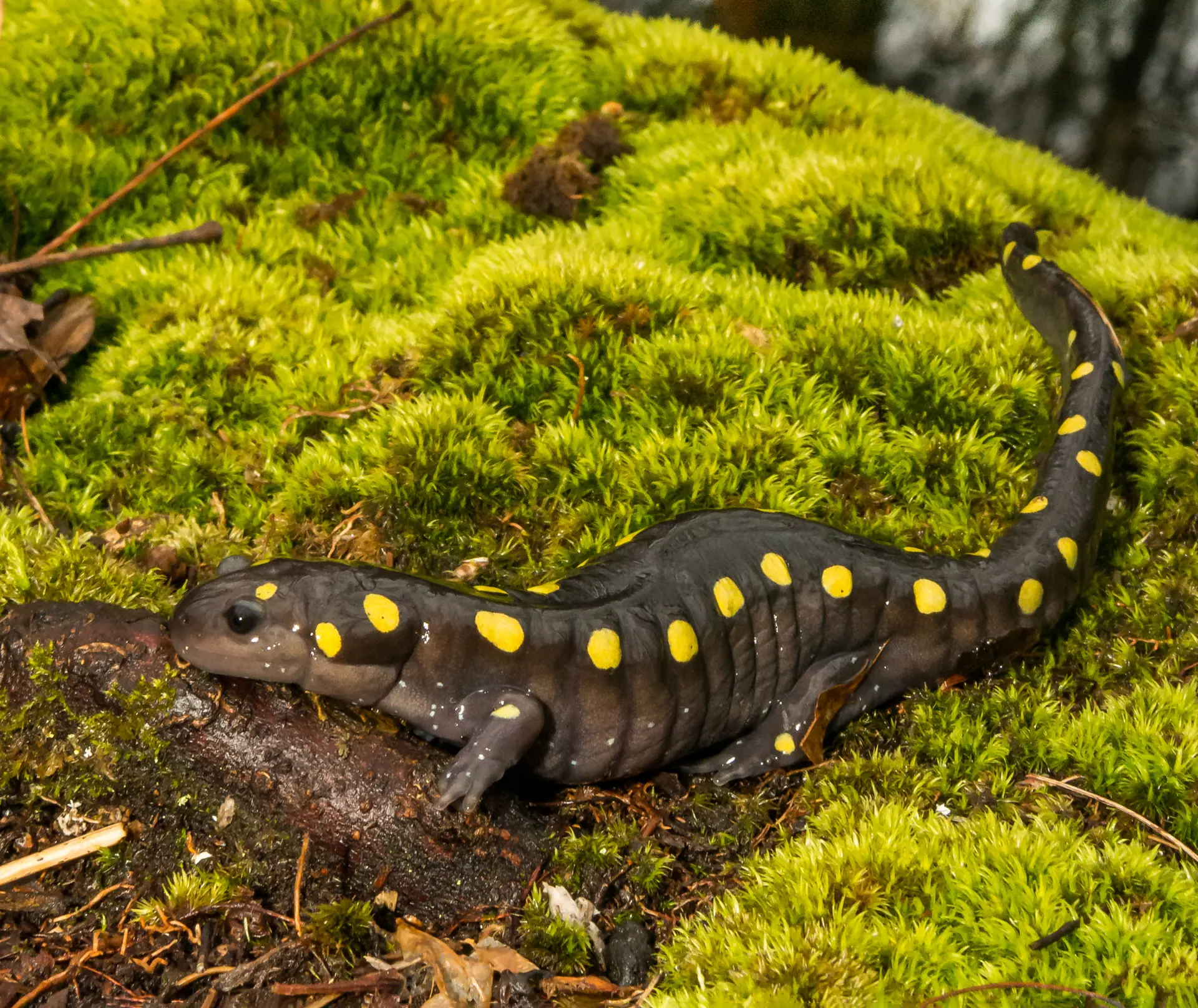
A family tradition every spring season, Jen Stepp, her husband and their two sons have witnessed the salamander migration for 20 years.
The first warm spring rain, and a corresponding rise in soil temperature, awakens some salamander populations like an alarm clock every spring. Roused from their dormant states underground, where they spend the majority of their lives, they make their way to vernal pools to mate, before retreating back underground.
Along with the spotted salamander (Ohio’s state amphibian), the Stepps also seek out two-lined salamanders, wood frogs, spring peepers and crayfish.
Gradually, Stepp has seen Northeast Ohio’s once-small flock of local amphibian fans expand.
“It started out being a couple dorks like me,” she says. “Now there’s so many social media sites. I’m a part of the Cuyahoga Valley Trail Enthusiasts (Facebook group). A lot of times, people will post on there, ‘It’s happening,’ and then the cars start showing up. There’s so many cars now that people are just parked on the side of the road.”
Stepp, a nurse who owns bearded dragons at home, says she used to pick up frogs and salamanders during the migration, but stopped touching the animals when she learned from a volunteer that oils in human skin can cause harm.
The annual amphibian migration brings a simple joy: a reminder that spring is around the corner.
Stepp and her family bond over their quirky tradition, waiting for the perfect conditions for the small, squirmy event that lands sometime between late February and early April every year.
Like the science behind their lifecycles, there’s a science to predicting when, exactly, the migration will take place. Eddie Lagucki is good at figuring it out.
“I’m kind of the salamander spidey-sense guy,” he says.
Lagucki has correctly predicted the migration in the four years he’s worked as the horticulture director at Kirtland’s Red Oak Camp, a not-for-profit summer camp that features a shallow concrete pond favored by an established population of spotted salamanders, along with Jefferson salamanders and Eastern newts.
On this annual evening, Red Oak Camp welcomes 30 visitors to view the salamanders as they make their pilgrimage. Attendees, chosen through a lottery system, are given red-light flashlights and instructions on the best viewing practices. Then, they watch as the ground comes alive with movement.
“Sometimes I feel like some people who are putting on events could be better at letting the general public know how fragile of an event this is like,” Lagucki says. “That is the main reason we have a restriction here, on how many people can come. In a way, it’s nature’s chaos that’s happening, but you don’t want to add human chaos on top of it.”
In recent years, local interest in the salamander migration has spiked, and Lagucki understands why. He says the migration is his “favorite night of the year,” and even got a life-sized tattoo of a spotted salamander after the 2025 event.
“When you get to experience an event like this, it allows you to really connect with nature on a deeper level and feel you’re a part of it,” Lagucki says. “It’s a magical experience.”
3 Tips to Safely View Migrating Salamanders
1. Use a Red Light. Red Oak Camp horticulture director Eddie Lagucki recommends avoiding white flashlights, which can confuse salamanders and make them pause. “They generally don’t see (red) wavelengths, so they’ll just keep going on their journey,” he says.
2. Don’t Bring Dogs Or Strollers. Step carefully, and avoid bringing strollers that can roll over the critters, says Cleveland Metroparks Nature Center manager Min-Sui Keung. Dogs can occasionally try to play with or eat the salamanders on migration nights.
3. No Touching. Keung says to watch, but don’t touch, the amphibians, which breathe through their skin. “We ask folks not to touch or handle the amphibians, so that your oils, your hand sanitizers, don’t transfer onto their skin, which could harm them,” Keung says.
RELATED: Critters of Cleveland: Meet Northeast Ohio's Cute, Resilient and Interesting Animals
For more updates about Cleveland, sign up for our Cleveland Magazine Daily newsletter, delivered to your inbox six times a week.
Cleveland Magazine is also available in print, featuring immersive stories, helpful guides and beautiful photography and design.

Annie Nickoloff
Annie Nickoloff is the senior editor of Cleveland Magazine. She has written for a variety of publications, including The Plain Dealer, Alternative Press Magazine, Belt Magazine, USA Today and Paste Magazine. She hosts a weekly indie radio show called Sunny Day on WRUW FM 91.1 Cleveland and enjoys frequenting Cleveland's music venues, hiking trails and pinball arcades.
Trending
-
1
-
2
-
3
-
4
-
5