
Cleveland’s Largest and Most Expensive Data Center May Rise Near Slavic Village
Developers are eyeing a three-building, 150-megawatt campus between Slavic Village and the industrial valley, a project that would rank among the region’s largest tech infrastructure investments.
by Ken Prendergast, NEOTrans | May. 6, 2026 | 10:00 AM

Courtesy of Google
This article was published through an exclusive content-sharing agreement with neo-trans.blog.
Set between Cleveland’s Slavic Village and the industrial valley in the coming years could be the city’s largest-ever data center. While at this early stage, it has generated many questions, its backers say the large site and nearby presence of industrial-scale electrical power and water resources should answer many of those questions.
Proposed is a $1.6-billion, 150-megawatt data center campus comprised of three buildings set on 35 acres currently owned by Morabito Enterprises, a longtime trucking firm with an address of 3560 E. 55th St. Morabito has been trying to sell its property off-market in recent years.
Seeking the data center campus is Lakeland Equity Group led by Managing Director Sam Khouri, whose family has been involved in many aspects of real estate in Greater Cleveland and beyond. Other partners also have strong real estate and financial backgrounds but not specifically when it comes to data centers.
Their real estate and financial backgrounds will certainly be necessary to pull off a project of this scale, complexity and, frankly, controversy. Khouri did not respond to an e-mail seeking more information prior to the publication of this article.
This article will be updated and/or followed up with his and other updates. This is a major, developing story.
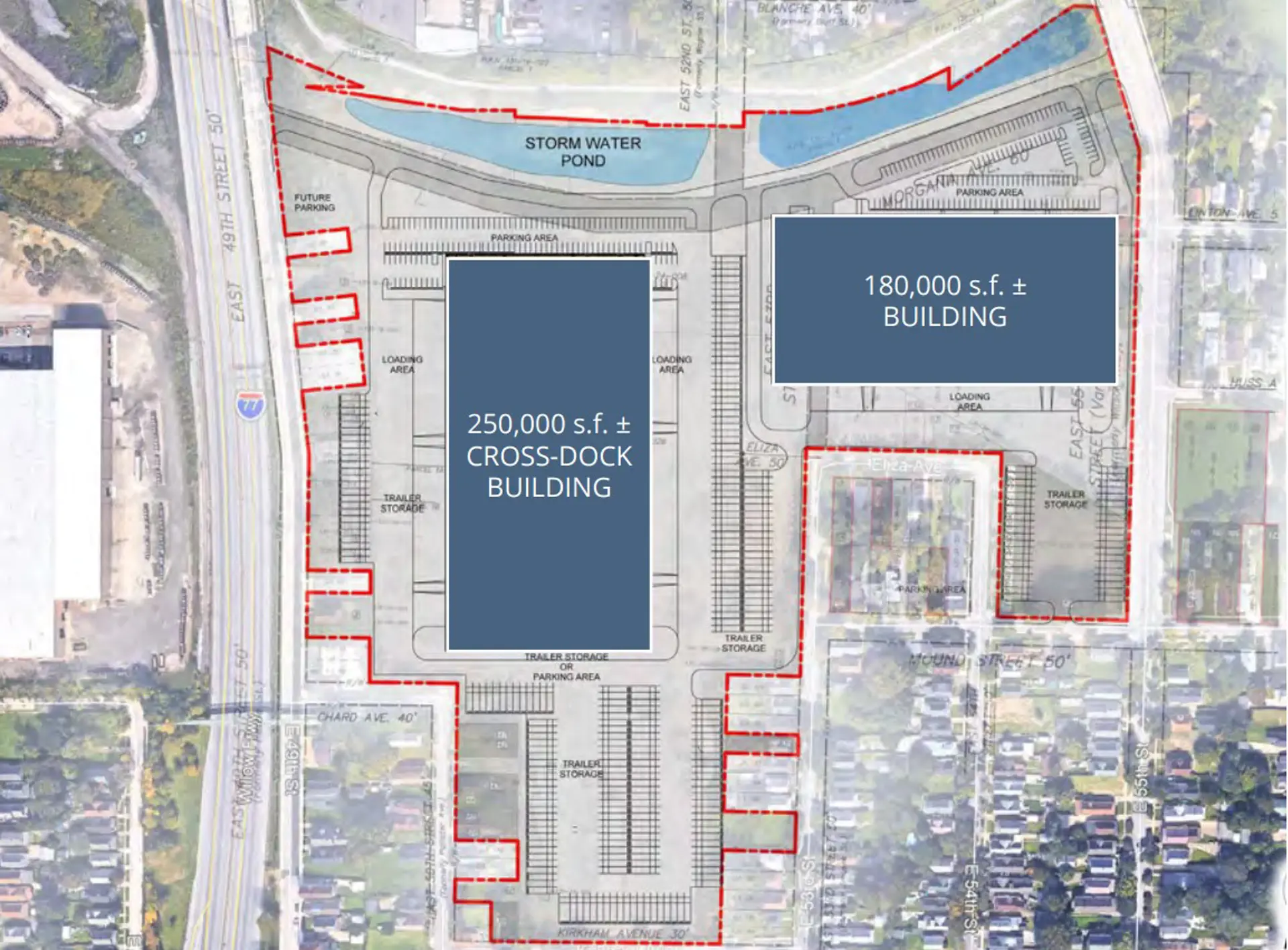
The trio of two-story buildings are projected to measure a total of 300,000 square feet and have a estimated development price tag of $1.6 billion — making it one of the most expensive private-sector real estate developments in Greater Cleveland history.
“We propose a premier 150-MW data center campus on a 35-acre site in Cleveland, designed to be the city’s first state-of-the-art hyperscale facility,” Khoury said in a permit application submitted yesterday to the city’s Building Department.
“The project will deliver secure, resilient digital infrastructure with advanced power, cooling, and fiber connectivity, supporting cloud, AI, and enterprise workloads while creating significant local investment and long-term technical jobs,” Khoury continued.
A 150 MW facility sits in the high-end of hyperscale, which is designed for high-density AI and cloud computing, consuming power equivalent to a small city. Some estimates say such a facility’s power demands could equate to roughly more than 100,000 homes.
This proposed data center would be banned under a proposed Ohio Prohibition of Data Center Construction Amendment that may appear on the ballot in Ohio as an initiated constitutional amendment this November.
The ballot initiative would prohibit the construction of data centers that are used for digital data processing with an aggregate power demand exceeding 25 megawatts. But time is running out on the gathering of enough petition signatures to put the question on the ballot in just five months.
Similarly sized facilities, such as one proposed in the west-suburban Baltimore community of Woodlawn, are also facing public opposition. These facilities typically occupy more than 40 acres of land and require dedicated utility substations to operate. As with Baltimore’s project, no end-user has yet been identified for Cleveland’s.
Here, Lakeland Equity Group’s $1.6 billion project costs includes $1 billion for construction and the rest for site preparation, infrastructure and other utilities, plus other indirect costs to accommodate data center.
An electrical power line runs along the north side of the site, next to the Morgana Run creek and trail. But it is not a cross-country, high-tension power line. The trail was built on the former right of way of Wheeling & Lake Erie Railroad.
Water to cool servers at the data center could from nearby watersheds or from a North East Ohio Regional Sewer District stormwater overflow tunnel under construction at the northwest corner of the Morabito property, next to East 49th Street. There will also need to be generators provided on-site for back-up power in the event of outages.
The Morabito site has been proposed for redevelopment before. The last time it was publicly noted was in the fall of 2021. Then it was proposed as a campus of warehouses and/or light-industries called Commerce Park 77, so-named because it is within sight of Interstate 77.
In that concept, the site was to host two buildings configured in different ways to provide anywhere from 400,000 to 500,000 square feet of space. There are also numerous nearby parcels owned by city and county land banks.
Morabito’s collection of properties grew larger in December 2025 when the 1.27-acre former Mound School property at Mound and East 55th streets was deeded to Morabito Enterprises by the Cleveland Metropolitan School District.
The Morabito brothers, Anthony and Benjamin, purchased their first property off East 55th from Hunkin Conkey Construction Co. in 1973 and continued adding land over the next few decades, said Ben Morabito.
The brothers operated and serviced a fleet of nearly 100 trucks from that site. But Anthony Morabito passed away at the age of 84 in February 2025, leading his brother to walk away from the business and sell the property.
After a significant clean up of the property, the Ohio Environmental Protection Agency inspected the area and made a finding of no further action (NFA) needed. The NFA related to corrective actions involving hydrocarbons and fuel contamination at a vehicle fueling station on the site.
For more updates about Cleveland, sign up for our Cleveland Magazine Daily newsletter, delivered to your inbox six times a week.
Cleveland Magazine is also available in print, featuring immersive stories, helpful guides and beautiful photography and design

Ken Prendergast, NEOTrans
Ken Prendergast is a local professional journalist who loves and cares about Cleveland, its history and its development. He has worked as a journalist for more than three decades for publications such as NEOtrans, Sun Newspapers, Ohio Passenger Rail News, Passenger Transport, and others. He also provided consulting services to transportation agencies, real estate firms, port authorities and nonprofit organizations. He runs NEOtrans Blog covers the Greater Cleveland region’s economic, development, real estate, construction and transportation news since 2011. His content is published on Cleveland Magazine as part of an exclusive sharing agreement.
Trending
-
1
-
2
-
3
-
4
-
5