
The Rock & Roll Hall of Fame Expansion Turns Up The Volume on Cleveland’s Rock Legacy
One of Cleveland's most beloved museums gets its own dedicated indoor music venue as one part of a $135 million expansion project.
by Annie Nickoloff | Oct. 30, 2026 | 5:00 AM

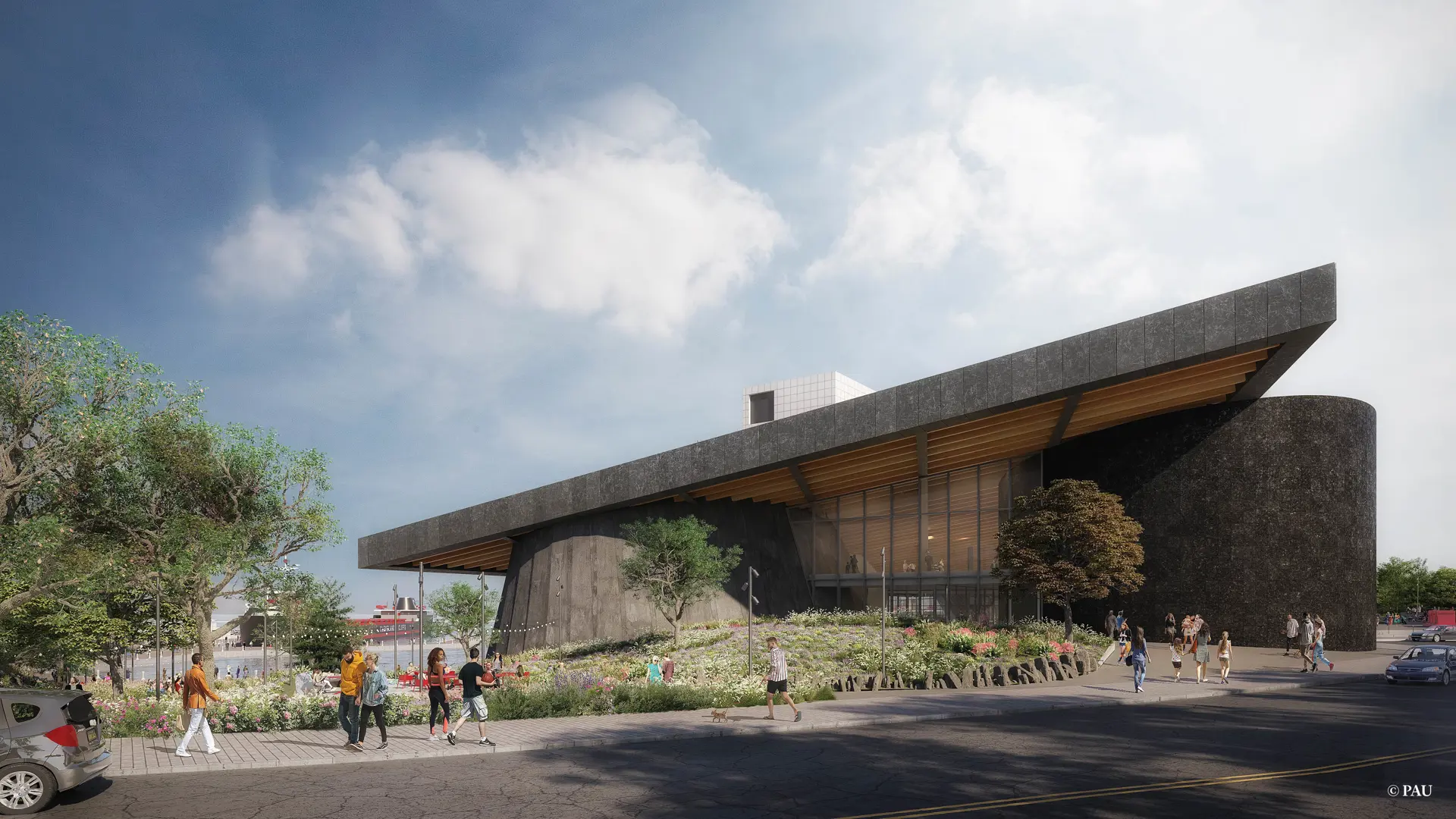
Image courtesy PAU
“This will be the biggest weekend the Rock Hall has this year,” Greg Harris, the Rock & Roll Hall of Fame president and CEO, says, “thanks to them.”
The fans. Specifically, Rush fans. In September, they’re in Cleveland for the prog-rock band’s two concerts — and they flood into the “Rush the Rock Hall” fan weekend, organized in collaboration with Toronto’s RushCon.
The frenetic rhythms of “YYZ” and “The Spirit of Radio” stream through the museum’s speakers, and the fans tap their hands to the beat on the escalator handrail. They riff on guitars in the interactive “The Garage” exhibit. They play a Rush pinball machine. They head to the Foster Theater for panel discussions featuring members of the Rush universe. They take photos with whiteboards showing how many Rush shows they’ve been to; their counts range from one to 62.
“We kind of make it the center of the universe for that particular artist, for that moment in time,” Harris says. “There’s ways to bring these fan communities together, and then good things happen.”
On Friday afternoon, Rush fans swarm the museum plaza’s bold red “ROCK & ROLL HALL OF FAME” letters (previously, “LONG LIVE ROCK”) for a group photo. Behind them, the Rock Hall’s glass pyramid shimmers, pointing into a sunny sky.
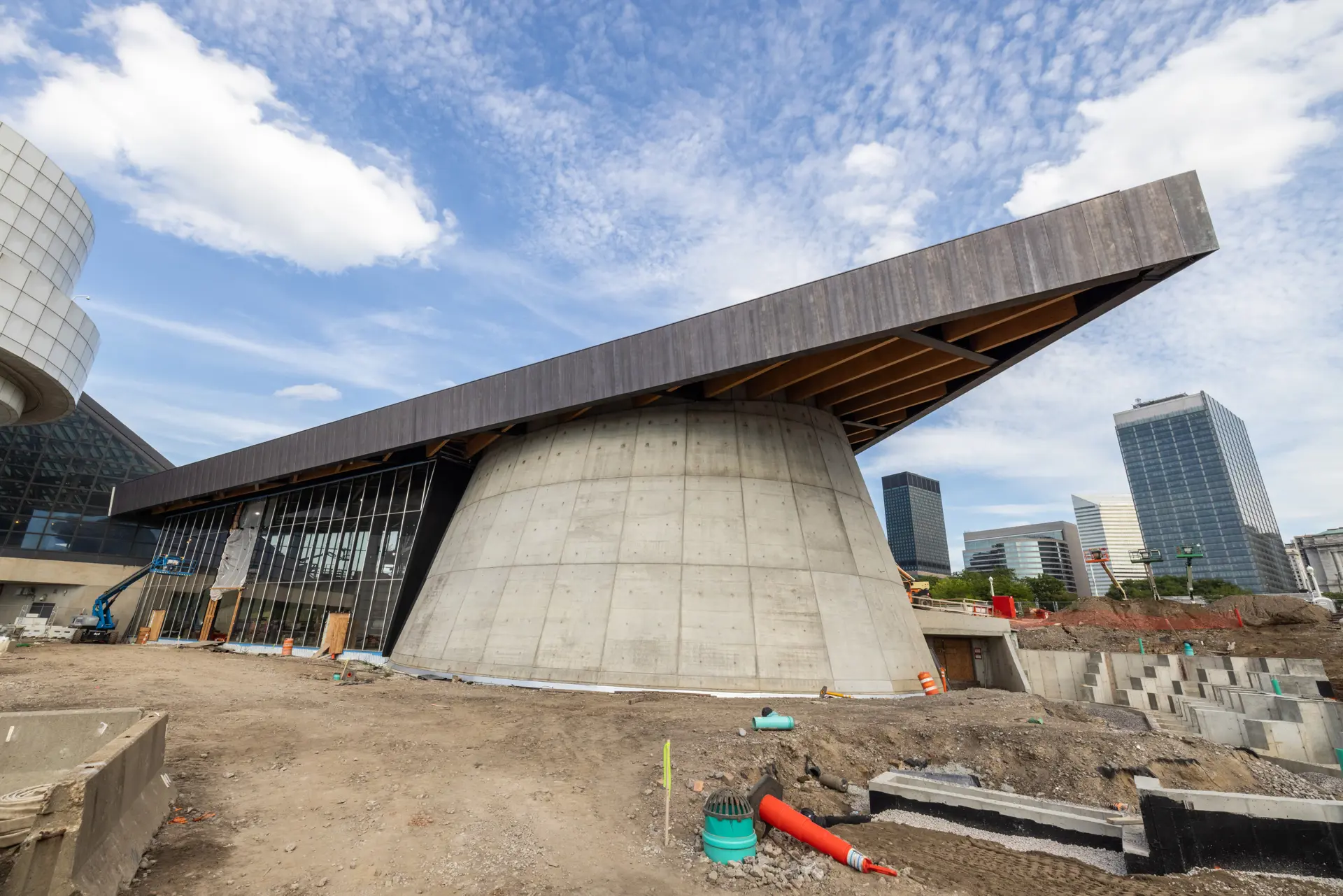
Next to it, a new, low triangular building creeps up along its left side, blocked by graffitied boards and construction tape. The $135 million expansion project, designed by New York-based firm Practice for Architecture and Urbanism, adds 50,000 square feet to the museum’s footprint and transforms the museum-going experience from start to finish.
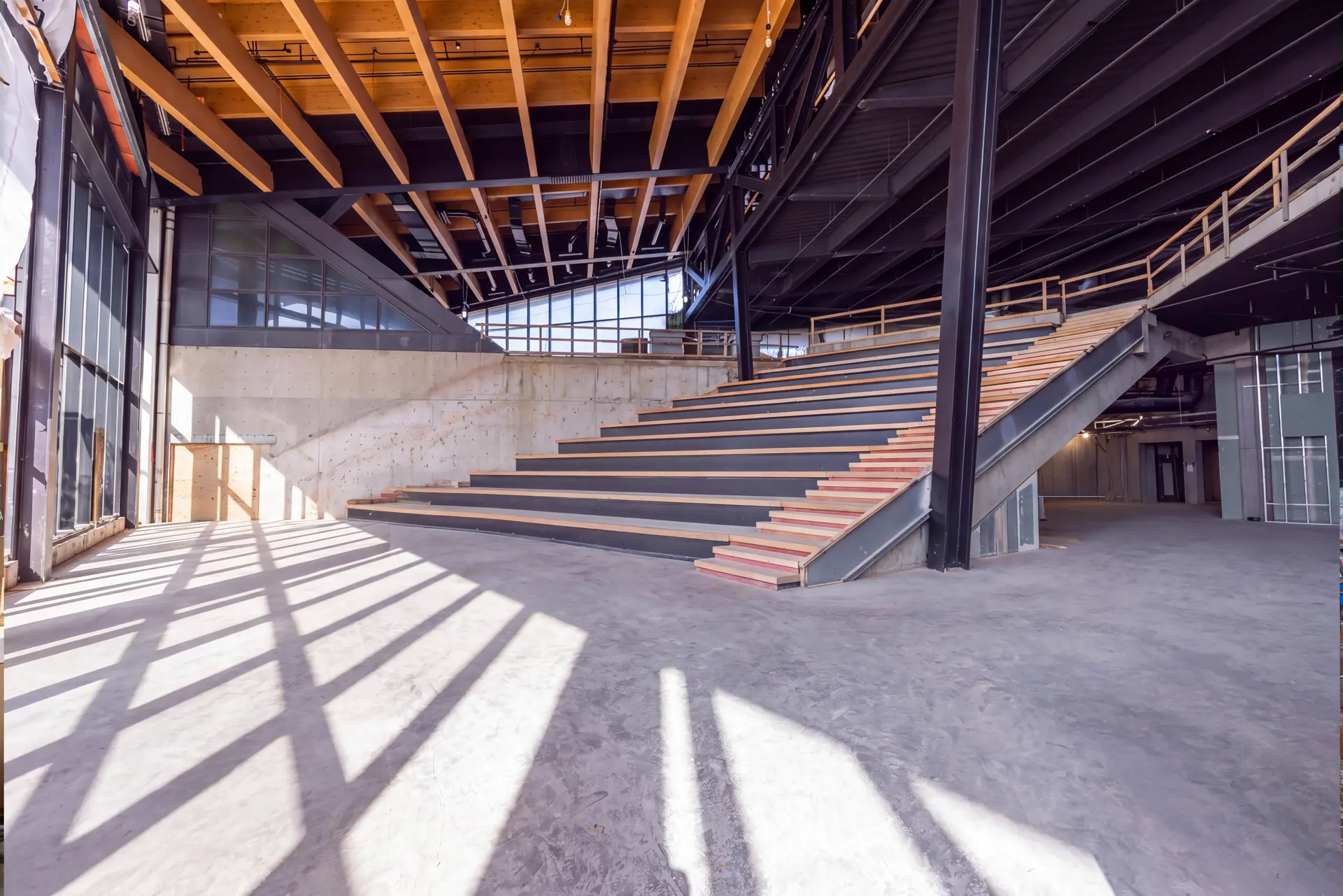
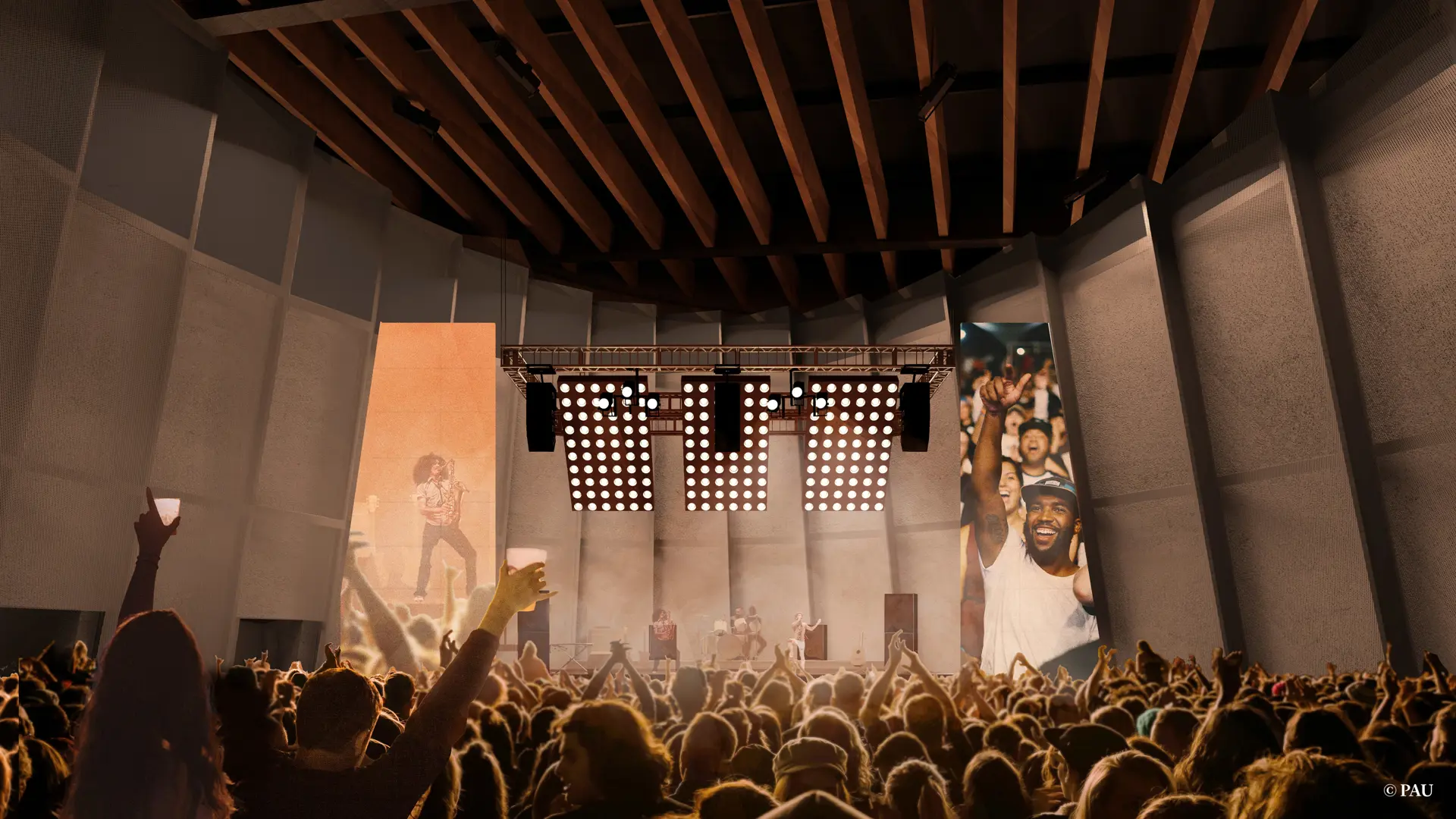
The building’s Haslam Atrium (named following a $10 million donation from Browns owners Jimmy and Dee Haslam) creates a new, grand entryway, its tall windows revealing views of Lake Erie and the side of the original pyramid. Outside, the Taylor Family Community Park forges a public space on a lakefront that’s lacked it. And, most notably, the oval-shaped Baker Hall music venue will host up to 1,400 people for concerts and private events. Despite the Rock Hall’s lengthy concert history, it’s the first time the museum has had a true, dedicated indoor music venue in its 31 years.
The expansion opens in November, with a community day slated for Nov. 22, and it signals even more incoming change at the Rock Hall. After its debut, the museum will immediately embark on its next project: a complete rethinking of its main exhibit hall, which houses the majority of the Rock Hall’s artifacts on view in the underground level. That project will be led by TAIT, an experience-driven Pennsylvania production company founded by Michael Tait, the former tour manager, sound engineer and lighting designer for prog-rock band Yes.
When the next redesign gets going, there will be more than 10,000 additional square feet of space in the building’s bottom level to work with — including a room specifically dedicated to hosting large-scale touring exhibits.
As they say: The beat goes on.
“We need to make sure that we’re relevant for visitors of all generations, and that we’re telling all these stories using the best possible tools that we can to tell those stories,” Harris says. “The exciting thing for us is that when we finish the main exhibition hall, the way that we access music and technology in our lives could change, as well.”
But one thing that will never change is the idea that live music — the raw, awesome, in-the-moment power of rock ’n’ roll — is at the center of it all.
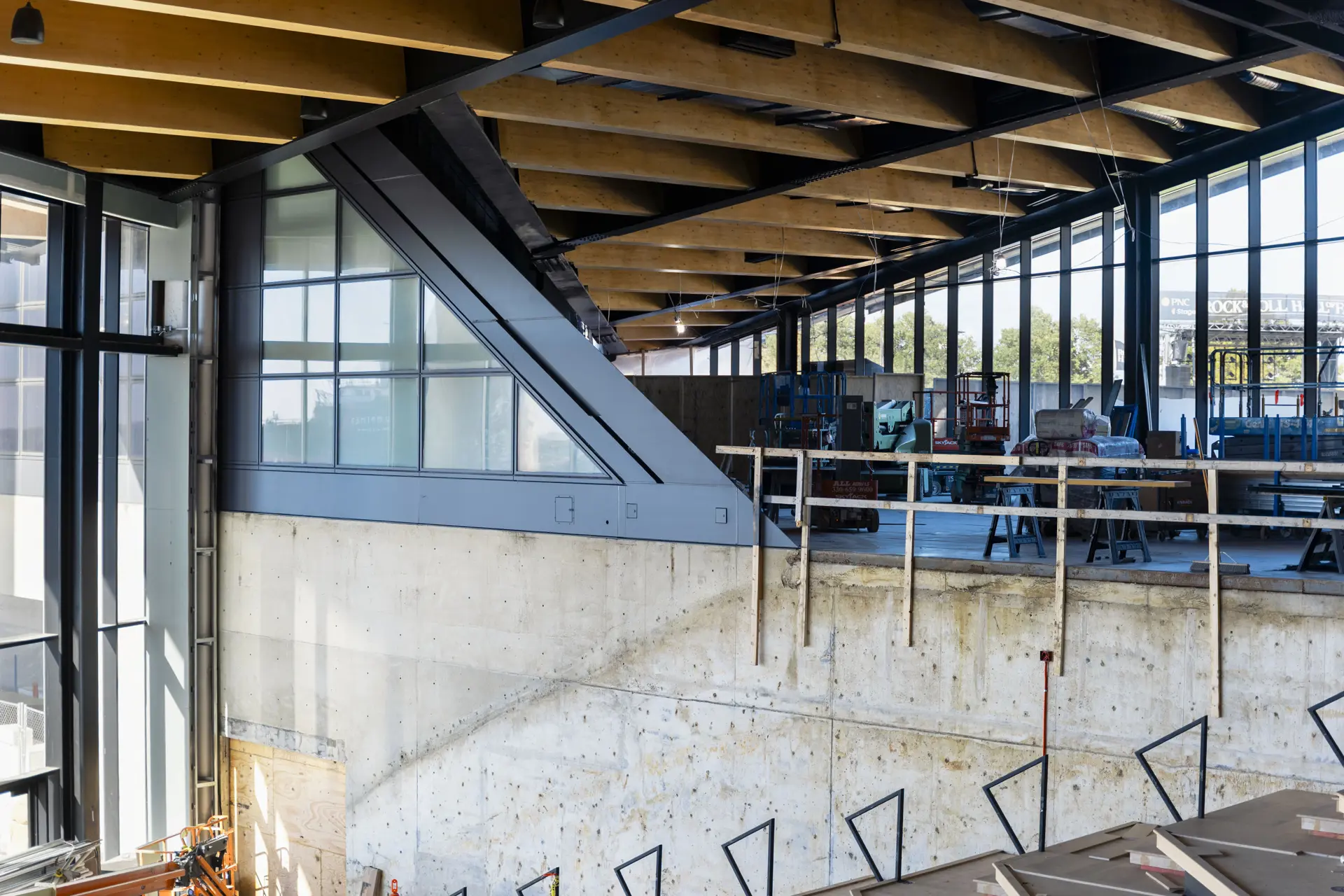
Old meets new: You can see where the forces collide. Inside the Rock Hall’s new digs, a shared wall connects the pyramid building with the modern triangular addition. A muddy line runs along the wall, dirtying the concrete above the atrium stairs. Previously, soil and stone filled everything beneath the line, in an underused hill in between the Rock Hall and the Great Lakes Science Center.
The line won’t be scrubbed away. Vishaan Chakrabarti, the architect of the Rock Hall’s expansion and the founder of PAU, insists on it.
“It’s a record of what was there. It’s not supposed to feel precious,” he says. “It’s not the Metropolitan Museum of Art. It is meant to feel like you can get down and dirty in this place.”
In the expansion, two architectural visions collide. The even pyramid designed by famed architect I.M. Pei connects with the PAU-designed expansion’s off-kilter triangle. The new building’s corners rest atop the elliptical Baker Hall venue, a round drum housing a stairwell, and an edge of the original pyramid.
“I.M. Pei is a hero of mine. He’s a legend,” Chakrabarti says. “It’s a masterwork. The thought of touching it is a terrifying thought. But it had to be touched.”
Pei, who famously designed the Louvre Pyramid in Paris, wanted the Rock Hall’s first building to capture the energy of live rock ’n’ roll. Glass windows reveal movement inside the buzzing room, as escalators move patrons up and down levels. It’s transparent, connective and true — like a favorite song.
The museum originally was designed to sit on the Cuyahoga River near Tower City Center before it shifted to its current spot on North Coast Harbor in 1990. The $92 million museum broke ground in 1993, and two years later, it debuted with a mind-blowing opening concert featuring the likes of Chuck Berry, Bob Dylan, Aretha Franklin, Bruce Springsteen and Little Richard.
RELATED: The Rock Hall Opened In 1995 With One of the Greatest Cleveland Concerts of All Time
The bones of the landmark are largely undisturbed in the expansion.
“While we’ve connected to the new building, besides a complicated gutter that runs above us to catch the water coming off the new roof and off the glass pyramid, we really haven’t done a lot to the old building,” says Rob Weil, the Rock Hall’s senior director of production and special projects. “We tried to just embrace it, as it was designed, by I.M. Pei.”
In September, Weil led a media tour through a space that was still in the works. In a side room of the original building, Rock Hall employees crammed into tight cubicles: a temporary workspace while their future offices came together next door. Three freshly painted classroom spaces in the new Howley Family Education Center were being readied for field trips and community programs starting in January.
Sound panels feathered out inside the elliptical Baker Hall venue, creating projection-friendly surfaces for shows. Outside, a worker pumped soil from a truck up to the green roof that helps to reduce stormwater runoff and maintain temperature control. Teams finished grading the gently sloping Taylor Family Community Park between Great Lakes Science Center and the Rock Hall: an accessible space which will be managed by the Cleveland Metroparks and will connect to the recently finished Mandel Community Trail along the lakefront.
Some improvements will never be seen by visitors. Tucked away, a chilly utility room houses the workings of a deep lake water cooling system — a first-of-its-kind tech for Northeast Ohio and Lake Erie. The eco-friendly design will keep the entire Rock Hall campus cool in the summer months.
In the winter months, visitors won’t have to bundle up to walk across a blustery plaza just to reach the front doors. The museum’s entryway will move into the expansion building, which is just a few steps away from Erieside Avenue. Entering the building, guests will flow down to the main exhibit level and through the remainder of the museum, scaling each level of the Pei pyramid as they always have.
The first taste of the Rock Hall will be, like rock ’n’ roll itself, diverse: full of sharp angst and rounded rhythm and everything in between. A visual concert of past musical influences, meeting new sounds.
“We’re trying to make it all read together almost like a set of instruments on stage,” Chakrabarti says about the expansion. “Great rock ’n’ roll is never boring, and it should wake you up, and it should make you feel alive, and it should make you think about the world anew. And I hope this space has a little taste of that.”
Chester Bennington and Mike Shinoda bobbed around a stage, lights dancing across the museum and the crowd of moshing Linkin Park fans, during the band’s 2001 performance on MTV’s Live at the Rock and Roll Hall of Fame series.
The TV show, which aired from 2001 until 2003 and featured acts such as Good Charlotte, Avril Lavigne and Godsmack, aimed to connect popular music with their influences in the Rock Hall. “Rock’s new school, at the old school,” a punky promotional video states about the series.
In Linkin Park’s appearance, the nu-metal band works through songs like “With You,” “Crawling” and “High Voltage.” During the band’s biggest hit, “In The End,” Bennington’s shouts echo back, bouncing around the room.
Acoustics were, somehow, not a factor in the initial glass-and-steel design of the Rock Hall.
“It’s a glass pyramid with steel pipes — and loud rock ’n’ roll music,” Harris says. “We needed the best sound people to dial it in, always.”
A stage was, somehow, also not a factor in the design of the Rock Hall. The MTV show is the reason the museum had any kind of indoor stage at all, for its first few decades. After the show ended, the temporary platform tucked in the lobby stuck around, and the museum worked with Eighth Day Sound to craft a suitable sound system around it. It became the landing spot for notable shows and the long-running Tri-C High School Rock Off.
But in the past decade, the museum moved the majority of its most consequential concerts outside to the plaza, and largely phased out the indoor lobby stage for ticketed shows. This summer, the Rock Hall Live schedule brought bands like Spoon, Kim Gordon and The Mountain Goats to the plaza’s open-air PNC Stage, while also highlighting standout local acts like Black Voltron, LoConti, LILIEAE, Big Indo and Chelsea Pastel.
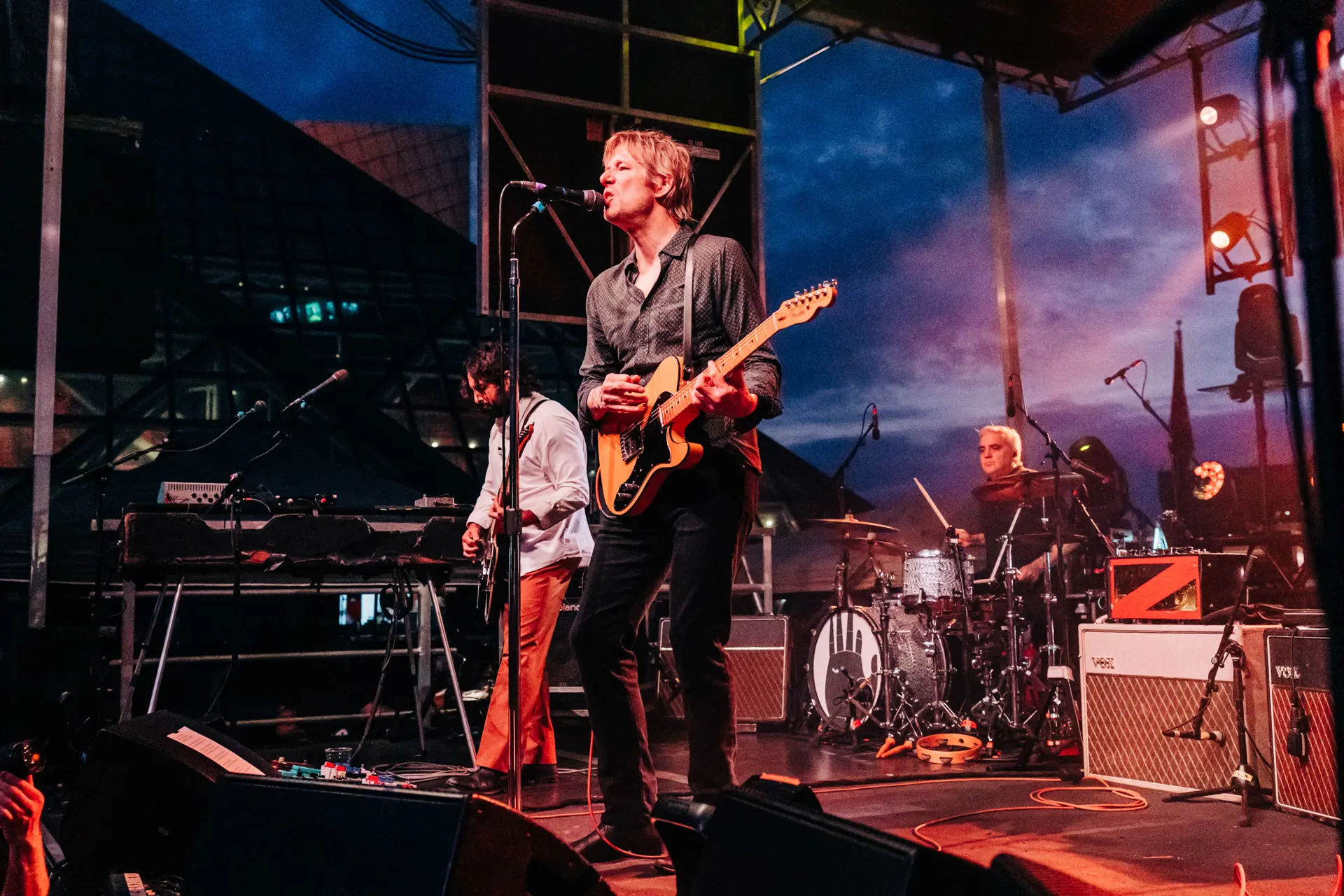
The iconic I.M. Pei building isn’t, and has never been, an ideal venue. In a lot of ways, it isn’t an ideal museum, either. Its pyramid shape forces exhibit spaces to shrink with each level in the building, culminating in the pointy, tall-ceilinged Level 6 (currently hosting an exhibit about Paul McCartney and Wings). Those above-ground gallery spaces were constricted further by the need to limit sunlight coming through the pyramid’s glass panes. For that reason, featured exhibitions from outside institutions have often been broken up between multiple galleries.
“For artifacts and exhibits, a glass pyramid is not a great place. Artifacts can’t be in direct sunlight,” Harris says. “You should not have wide swings in temperature, humidity, and climate control. And as a result, most of our exhibit space is underground and under our front plaza.”
Yet, since it opened in 1995, the architectural feat has become known the world over as an emblem of Cleveland’s place in rock ’n’ roll history. In that time, the museum team has learned to work with its quirks.
“Our pyramid itself is a beautiful, iconic building, and we all made a pact as a team about 10 years ago or so to maximize every inch of the pyramid before we would contemplate an expansion,” Harris says.
Inch by inch, inside and outside: In 2016, the Rock Hall installed its bold letters on its front plaza and opened its outdoor stage, kick-starting its “Museum 2.0” initiative. In 2017, the Rock Hall debuted the improved Connor Theater on Level 3, featuring an experiential 12-minute Power of Rock film complete with flashing stage lights and moving screens. It was coupled with a fresh gallery wall including every person who’s been inducted into the Hall of Fame thus far. Along the way, it refreshed its retail operations and built an on-site kitchen.
Then, in 2019, the museum debuted its experiential jam room called The Garage on Level 2, next door to a sticker-designing station and a set of band-themed pinball machines. It’s a culmination of the museum’s focus on interactive spaces, something it hopes to establish with new technology and exhibits in its upcoming main level renovation next year.
“When the museum was first built, there were no pop culture, rock ’n’ roll, or music museums of this caliber in the world; we were the first of our kind. So I think when the building was being built, they weren’t quite sure at that time what was going to happen in here. What would a rock ’n’ roll museum look like? What would it do?” says Jason Hanley, the Rock Hall’s vice president of education and visitor engagement. “But now that we’ve grown and we continue to grow, we knew what we needed.”
By the time the expansion broke ground in 2023, the Rock Hall had a vision: a home for year-round music events, dedicated areas for students and education programs, more space for community gatherings. The expansion embodies the “Museum 2.0” thinking learned from decades of operations and growth.
Unsurprisingly, the vision centers itself on music — whether in the air, on the stage or at your fingertips.
“We are a museum that’s dedicated to the living, breathing art form of rock ’n’ roll,” Harris says, “and live music is important to that.”
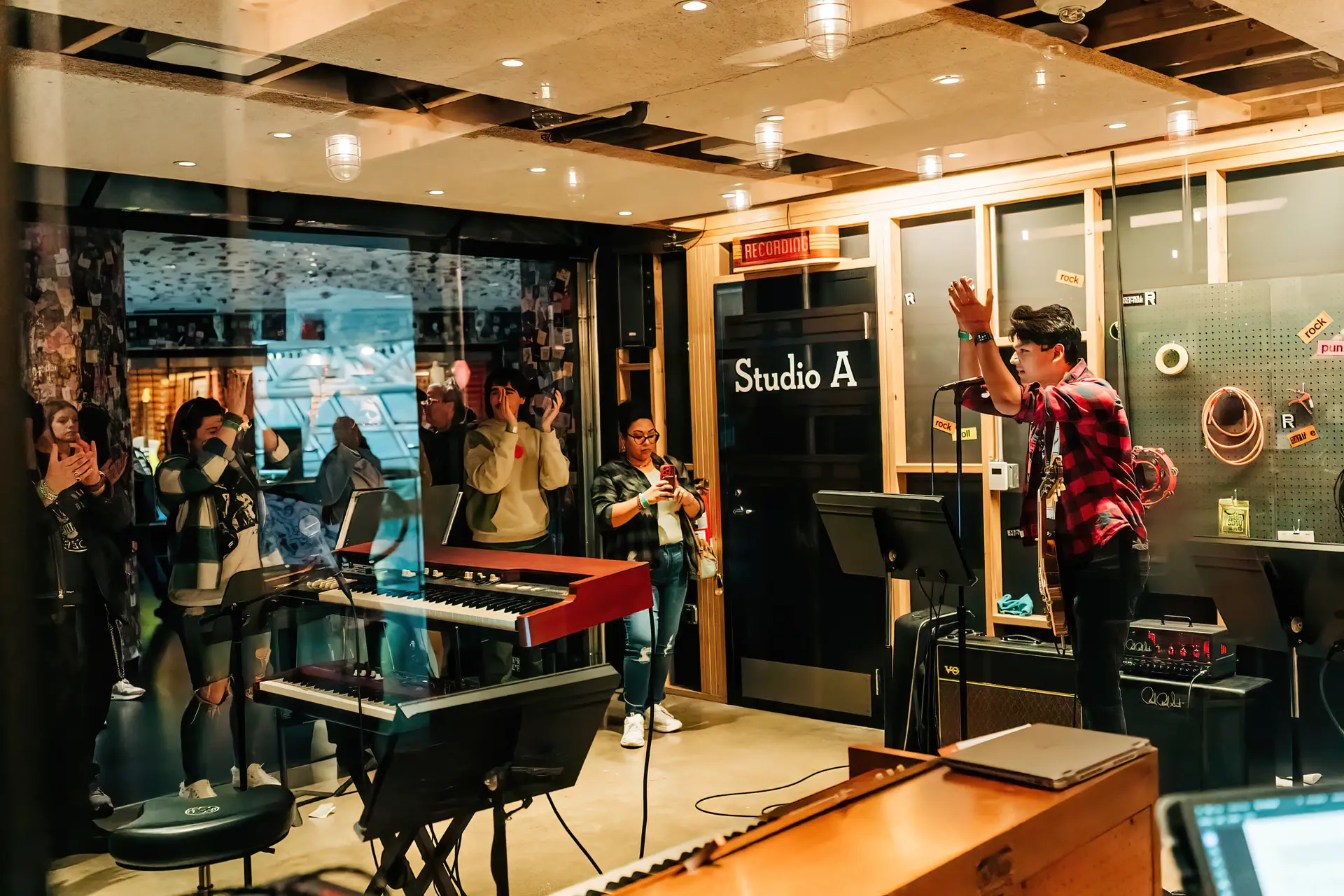
When he walks into the Rock Hall for a day of work, Mark Zach heads directly to The Garage exhibit on Level 2. He cleans and tunes up the drum set, keyboards and row of guitars for guests to use when they come in.
By noon, he’s jamming.
“That is when the live music takes over for the day,” says Zach, the Rock Hall’s manager of fan engagement programming. “For the next couple of hours, we’re playing live music with guests that come in.”
A group of eight musicians staffs The Garage. They call themselves “The Mechanics.” The team knows more than 200 songs by heart and can back up museum guests of all skill levels, all day long, in a space that’s designed to look like a music-lover’s garage — mirroring the origin stories of many Rock & Roll Hall of Fame inductees.
When The White Stripes were inducted in 2025, singer-guitarist Jack White reflected on his scrappy beginnings in his speech, inspired by his band’s 2001 song “Little Room”: “To the young artist, I want to say, drop the screens, get your hands dirty, get out in your garage, or your little room, and get obsessed. Get obsessed with something.”
When OutKast was inducted later that night, member André 3000 emotionally recounted White’s words. “He said something about little rooms. And we started in a little room,” the artist said, teary-eyed. “Great things start in little rooms.”

Even The Mechanics have branched out of their little room on Level 2, expanding from The Garage to become the Rock Hall’s de facto house band. Performing with a few other rotating members of museum staff, the group has been a mainstay at fan days, private events and educational programs since The Garage opened in 2019.
“We were coming up to Black Friday and our Thanksgiving rush, which are some of our bigger days in the fall, and we were thinking of ways to add to these busier days, so I came up with a suggestion: How about we just have some of the Garage musicians do a lunch set and play for two hours?” Zach says. “We played all weekend, and it became such a hit that we did it through December. We did some holiday sets. That really solidified The Mechanics as the house band going forward.”
Live performances — not just artifacts — are woven into the fabric of the Rock Hall. The artist-in-residence program hosts an annual group of Northeast Ohio musicians and provides mentorship and weekly performance opportunities at the museum. The long-running Toddler Rock program hands kids instruments for the first time in their lives.
And in The Garage, visitors of any background can rock out, even if they have no idea what they’re doing.
“There’s a lot of people that, when they come into the space, they say, ‘Oh, well, I’m too old to start,’ or, ‘I couldn’t do this,’” Zach says. “By working with them for five minutes, we can get them playing a basic beat or playing a couple simple chords, and then we bring them into the jam room and rock. We fill out the band, and so they get to experience being a musician for the first time.”
“All the years of hip-hop, the Rock & Roll Hall of Fame committee finally figured out what we’d all figured out years ago,” RZA said, surrounded by the nine other members of hip-hop group Wu-Tang Clan, at their Blossom Music Center farewell tour stop in September. Then, he launched into the next song, buoyed by a crowd singalong: “And if you want beef, then bring the ruckus. Wu-Tang Clan ain’t nothing to f*** with!”
RELATED: Wu-Tang Clan and Bone Thugs-N-Harmony Impress in Nostalgic Blossom Hip-Hop Concert
At a Nov. 14 ceremony at Los Angeles’ Peacock Theater, Wu-Tang Clan will be inducted into the Rock Hall, with fellow members of the performer category (Phil Collins, Billy Idol, Iron Maiden, Joy Division/New Order, Oasis, Sade and Luther Vandross) and members of other categories (Celia Cruz, Fela Kuti, Queen Latifah, MC Lyte, Gram Parsons, Linda Creed, Arif Mardin, Jimmy Miller, Rick Rubin and Ed Sullivan).
Hip-hop, and smooth jazz, and punk, and new wave, and R&B, and country rock, and Afrobeat, and heavy metal — yes, it’s all rock ’n’ roll.
Critics of the Rock & Roll Hall of Fame claim that the museum uses too expansive a definition of “rock ’n’ roll,” and that it pulls from other genre-specific institutions such as Memphis’ Blues Hall of Fame and Nashville’s Country Music Hall of Fame. Famously, country icon Dolly Parton declined her 2022 induction, saying she didn’t feel she “had earned that right,” before reversing her decision, accepting the nomination and releasing what became her final studio album, Rockstar, in 2023.
RELATED: Rock Hall-Inspired Album Puts Dolly Parton With Rock’s Great Stars
But rock ’n’ roll isn’t really a genre, Harris says. “It’s an attitude and a spirit. It’s not a sound. It challenges convention. It pushes the status quo. It’s about attitude.”
“It is this ever-changing art form,” Chakrabarti says, “that is about channeling youth, and the anger of youth, the dissatisfaction of youth.”
Entering the museum’s expansion filled with clashing angles and shapes, past and present fold into one story. Through the Haslam atrium window, visitors see a clear view of the rock ’n’ roll city: the place where DJ Alan Freed famously popularized the term “rock ’n’ roll,” the place that hosted the Moondog Coronation Ball in 1952 (widely considered the first rock ’n’ roll concert), the place where WMMS radio famously broke bands and artists such as Bruce Springsteen, Fleetwood Mac, David Bowie and Rush.
In this open atrium, before seeing a single exhibit or inductee signature, visitors will be dipped into that legacy. The goal of it all, Harris says, is for everyone to see how encompassing rock ’n’ roll is.
It’s a superfan seeing her 62nd concert. It’s a 2000s nu-metal mosh pit. It’s a rap group’s farewell tour at Blossom. It’s a country star’s final act. It’s a little kid, banging on a drum.
It’s in our headphones, and on a stage, and preserved in an exhibit.
As they say: It’s still rock ’n’ roll to me.
“Rock ’n’ roll is the most powerful art form. It’s around the world. It’s so broad and so diverse, and so powerful as a social force, as a connector, as an inspiration,” Harris says. “We’re no longer trying to justify that rock ’n’ roll belongs in a museum.”
It’s living and breathing.
Live and alive.
For more updates about Cleveland, sign up for our Cleveland Magazine Daily newsletter, delivered to your inbox six times a week.
Cleveland Magazine is also available in print, featuring immersive stories, helpful guides and beautiful photography and design.

Annie Nickoloff
Annie Nickoloff is the senior editor of Cleveland Magazine. She has written for a variety of publications, including The Plain Dealer, Alternative Press Magazine, Belt Magazine, USA Today and Paste Magazine. She hosts a weekly indie radio show called Sunny Day on WRUW FM 91.1 Cleveland and enjoys frequenting Cleveland's music venues, hiking trails and pinball arcades.
Trending
-
1
-
2
-
3
-
4
-
5